
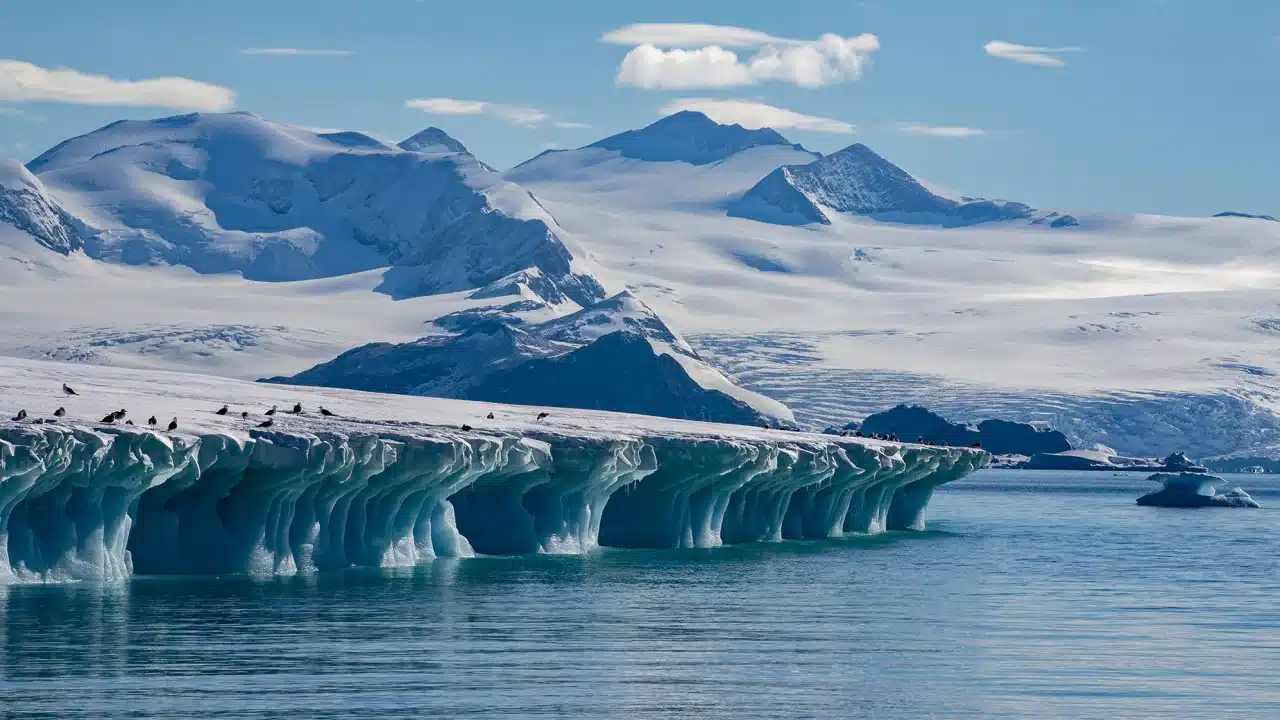
A paper claims that deep ocean water in the Antarctic is warming and contracting, which might have significant effects on climate change and deep ocean ecosystems.
The world’s coldest, saltiest water is referred to as “Antarctic bottom water.” By absorbing excess heat and carbon pollution from humans, these waters are essential to the ocean’s ability to act as a barrier against climate change. They also move nutrients around the ocean.
However, the Weddell Sea along Antarctica’s northern coast is experiencing a loss in this crucial water mass as a result of long-term shifts in winds and sea ice, according to a report released on Monday by the British Antarctic Survey.
Scientists used decades of data taken by ships as well as from satellites to assess the volume, temperature and saltiness of this slice of deep Antarctic Ocean.
“Some of these sections were first visited as far back as 1989, making them some of the most comprehensively sampled regions in the Weddell Sea,” Povl Abrahamsen, a physical oceanographer at BAS and co-author, said in a statement.
They found that the volume of the cold bottom waters has shrunk by more than 20% over the past three decades. They also found that ocean waters deeper than 2,000 meters (6,600 feet) have warmed four times faster than the rest of the global ocean.
“We used to think that changes in the deep ocean could only occur over centuries. But these key observations from the Weddell Sea show that changes in the dark abyss can take place over just a few decades,” Alessandro Silvano from the University of Southampton in the UK, a co-author of the study, said in a statement.
The reason these deep waters are shrinking is down to changes in sea ice formation caused by weakening winds, the study found. Stronger winds tend to push ice away from the ice shelf, which leaves areas of water open for more ice to form. Weaker winds have meant these gaps are smaller, slowing sea ice creation, according to the study.
New sea ice is vital to create the Weddell Sea’s very cold, salty water. As the water freezes, it pushes out salt and as salty water is denser, it sinks to the bottom of the ocean.
The changes in these deep waters can have far-reaching consequences. They are a vital part of global ocean circulation, transporting human-caused carbon pollution into the deep ocean where it remains for centuries, said Silvano. If this deep circulation weakens, “less carbon can be absorbed by the deep ocean, limiting the ability of the ocean to mitigate global warming,” Silvano told CNN.
Oceans have absorbed more than 90% of the world’s excess heat since the 1970s and absorb almost a third of human-produced carbon pollution.
This cold, dense water also has a vital role in supplying oxygen to deep ocean waters. How and whether deep ecosystems could adapt to less oxygen “is unclear,” added Silvano.
Holly Ayres, a researcher at the department of meteorology at Reading University in the UK who was not involved in the study, said the BAS research is a step forward in our knowledge about deep ocean water in the Antarctic.
“To have combined decades of ship-based observations and satellite data is a big leap in our understanding of the formation process, and may be helpful in our understanding of how Antarctic bottom water will form in the future,” Ayres told CNN.
While the changes the study identified are the result of natural climate variability, climate change is also having an impact on Antarctica’s deep waters.
In a March study, scientists found that melting ice is diluting the saltiness of the ocean and slowing down the the circulation of deep ocean water in the Antarctic. Failure to limit planet-heating pollution could lead to the collapse of the circulation of deep ocean water, with potentially devastating consequences for the climate and marine life, the report found.
BAS new study is “an early warning” Shenjie Zhou, an oceanographer at BAS and lead author of the study, told CNN. “The ongoing changes in the deep water layer in the Antarctic are already happening and it’s not heading in the direction that we want.”