
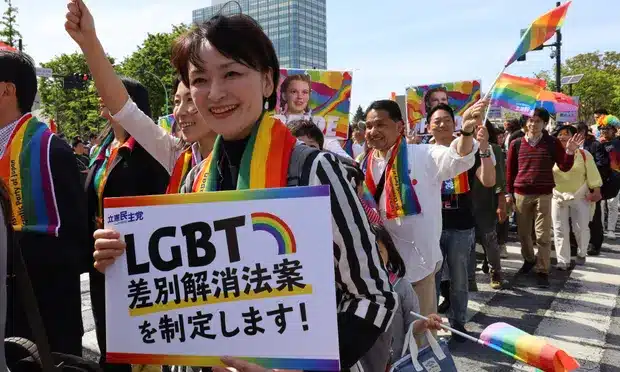
A court in Japan has delivered a ruling stating that the country’s prohibition on same-sex marriage is currently “in a state of unconstitutionality,” though it stopped short of declaring it outright unconstitutional.
This decision has added complexity to the ongoing debate surrounding LGBTQ+ rights in Japan.
The recent ruling from the Fukuoka district court aligns with a similar judgment made by a Tokyo court in 2022. It represents the final of five anticipated rulings within Japan’s district court system.
Interestingly, the five district courts have individually reached three different conclusions in response to lawsuits brought forward by members of the LGBTQ+ community.
Two courts have declared the ban on same-sex marriage to be unconstitutional, while one has deemed it constitutional. The remaining two courts have stated that it is “in a state of unconstitutionality.”
In 2022, an Osaka court upheld the ban, citing conformity with the postwar constitution’s definition of marriage as being based on “the mutual consent of both sexes.” Conversely, courts in Sapporo and Nagoya determined that the policy violated the constitution.
Plaintiffs in the Sapporo, Osaka and Tokyo court cases have all appealed against the rulings after their damages claims were dismissed.
On Thursday, the Fukuoka court said current marriage laws were “in a state that violates” a section of article 24 of the constitution that refers to “individual dignity and equality of the sexes”, according to the Kyodo news agency.
But the court ruled that the current legal framework did not violate other parts of the constitution, including a clause that ensures equality before the law.
Japan, the only G7 country that does not legally recognise same-sex unions, has come under mounting pressure to promote marriage equality.
The court in Fukuoka rejected a demand by three LGBTQ+ couples that the state pay them damages for denying them the right to marry, according to Kyodo. The four other courts also dismissed compensation claims.
A lawyer for the plaintiffs said details of the ruling were still being verified, adding that he thought it was likely to be similar to that of the Tokyo court.
The five rulings have reignited the debate over same-sex unions, days before Japan’s parliament is expected to pass a bill that will promote “understanding” of members of the LGBT+ community but does not address the lack of legal status for same-sex couples.
The bill was due to be debated before the recent G7 summit in Hiroshima, but opposition from conservatives inside the ruling Liberal Democratic party (LDP) forced the government to submit a watered-down version.
The bill originally said “discrimination is unacceptable” but now states that “unfair discrimination” should not be tolerated – wording that critics say has rendered the legislation meaningless.
While campaigners have welcomed court rulings describing the ban as a violation of constitutional rights, the lack of unanimity could be viewed as a minor setback in the campaign for marriage equality.
The prime minister, Fumio Kishida, has argued that the ban on same-sex marriage is “not discriminatory” and that legalising it would “fundamentally change society”.
Critics have accused Kishida of pandering to conservatives in his party while ignoring opinion polls showing that up to 70% of people support legalising same-sex unions.
Several members of his party have been criticised for making homophobic remarks, and Kishida sacked a senior aide earlier this year after he said that he would not want to live next door to an LGBTQ+ couple.
Business lobbies have called for change, arguing that Japan will struggle to remain globally competitive unless it does more to promote diversity, including marriage equality.
More than 300 municipalities in Japan allow same-sex couples to enter partnership agreements, but their rights are limited. Partners are not permitted to inherit each other’s assets or have parental rights to each other’s children, and there is no legal guarantee that they can visit each other in hospital.